
OEM AND AFTERMARKET PART NUMBERS
A customer walks in with a number off the old part. Whether that number helps depends on whose number it is, and on a cross-reference somebody had to build.
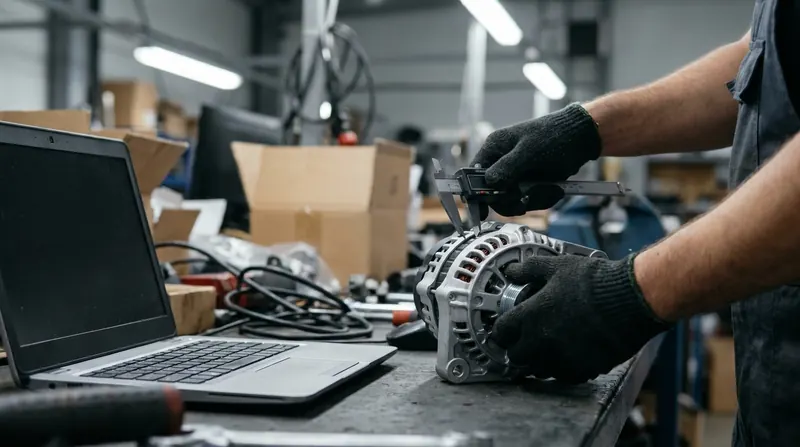
Whose number is it?
The same physical part can carry several different numbers, each meaningful to a different company.
- OEM part number. Assigned by the vehicle manufacturer. This is what the dealer orders by and what appears in the manufacturer's parts catalogue.
- OE supplier number. Many original parts are made by a component supplier, which has its own number for the same part.
- Aftermarket part number. Assigned by an aftermarket brand to its replacement for that part. Each brand has its own numbering scheme.
- Casting or engineering number. Marked on the component during manufacture. It identifies a casting or design, which may be shared by several finished parts.
- Private label number. The same aftermarket part, boxed under a store or program brand with a different number again.
The first job at the counter is working out which kind of number the customer has brought. A casting number typed into an OEM lookup finds nothing, and the customer concludes the part is not available.
How a cross-reference works
A cross-reference, or interchange, is a table of pairs: this number can be replaced by that number. Somebody has to build each pair, and there are three sources.
- The aftermarket brand. When a brand designs a replacement, it records which OEM numbers the part replaces. This is the most reliable source, because the brand engineered the part against the original.
- Brand-to-brand interchange. Brands and distributors publish which competitor numbers their parts correspond to, so a store changing lines can convert its stock.
- Derived matches. If two parts both replace the same OEM number, a system may infer that they replace each other. Useful, but one step further from anyone's engineering.
Why a match is not always a fit
Interchange describes a relationship between two parts. Fitment describes a relationship between a part and a vehicle. They usually agree, and the exceptions are where comebacks start.
- Consolidation. Aftermarket brands often replace several OEM numbers with one part. That part fits all of those vehicles. An OEM number, going the other way, may fit only one of them.
- One-way relationships. A newer part may replace an older one, while the older part cannot be used where the newer one is specified.
- Different coverage. Brand A lists its part for eight model years. Brand B's equivalent is listed for six. For the other two years, the interchange exists but B has not said its part fits.
- Design differences. Equivalent parts can differ in connector, mounting hardware or included components. They do the same job and install differently.
- Grade. An economy and a premium part may cross to the same OEM number and not be what the customer expects in place of each other.
The working rule: use the cross-reference to find the candidate, then confirm the candidate's own application for the customer's vehicle.
Good practice at the counter
- Ask where the number came from: the box, the invoice, or the part itself.
- If it came off the part, check whether it is a casting number before searching.
- After a cross-reference, look the replacement up by vehicle as well.
- Compare the old part with the new one before the customer leaves, when the old part is there.
- When an interchange proves wrong, report it. The record only improves if someone corrects it.
For the people who maintain the data
If you publish a product line, your OEM cross-references are how your part gets found when the customer starts from the original number. Keeping them complete and current is as valuable as the fitment itself. How to create a parts catalogue covers where interchange fits into the work, and catalogue management describes the tools we are building for it.
Common questions
What is an OEM part number?
The number the vehicle manufacturer assigns to a part in its own parts system. It is the number a dealer's parts department orders by.
Is the number cast into a part the part number?
Often not. Numbers cast or stamped into a component are frequently casting or engineering numbers, which identify a component of the assembly and not the part as it is sold.
Does a cross-reference guarantee the part will fit?
No. It tells you the two parts are intended as equivalents. Check the replacement's own application for the specific vehicle before selling it.